A seamstress pricing guide: how to price every job without guessing
Ask ten seamstresses how they price a bridal hem and you'll get ten answers. Some charge by the metre of hemline. Some charge by the layer. Some just look at the dress and say a number that feels about right.
The feel-it method works until it doesn't. One day you quote a chiffon hem with a lace edge the same as a plain satin one, then spend the whole weekend on it for the same money.
This guide is about building a pricing structure you can quote from with confidence, the same way every time. If you haven't worked out your hourly rate yet, start with how much to charge for alterations and come back.
Price by time, show by job
The fairest pricing system we've found is simple to say out loud: every job price is your usual time for that job, multiplied by one hourly rate.
You don't need to show the bride your hourly rate or your minutes. She sees "two-layer hem, plain fabric: $165". Behind that price sits a real number you've measured, so you can defend it, and you can adjust it when your times change.
Why one rate? Because the skill doesn't change between jobs, the time does. A lace hem isn't harder in a way that deserves a higher rate per hour. It takes longer, so it costs more. One rate keeps your maths clean and your quotes consistent.
Build your price list around complexity, not just the job
The same job can take very different amounts of time depending on the dress. For bridal work, we find two questions sort almost every dress:
Is the fabric plain? Satin, crepe, mikado, a straightforward tulle. Nothing gets in the way of the needle.
Is there trim or lace you have to work around? A scalloped lace edge, a lace overlay, a trim that has to be lifted and reset.
And one more level for the slow ones:
Is there applique or beading to lift off and put back? Hand work, piece by piece.
So instead of one price for "hem", you have a price for each level, and each comes from its own time. Brides understand this immediately when you show them the lace edge on their own dress.
Small parts get a per-unit price
Some things are easier to price per item than per job:
- Extra bustle points (around 8 minutes each)
- Hand-sewn buttons (about 2 minutes each)
- Snaps and hooks and eyes (roughly 9 minutes each)
- Button loops (also about 9 minutes each)
Multiply by your rate and round up to something tidy. When a bride wants a 22-point bustle, you're not guessing. You're counting.
Materials go on their own line
Keep materials separate from labour. Horsehair braid, a replacement zip, lace for a new strap, boning, cups. Charge what they cost you plus a handling margin for the time spent sourcing them.
This keeps your labour prices stable even when a bride brings in a dress that needs unusual supplies, and it makes your quotes easier to explain.
Set a minimum charge
Every job carries overhead that has nothing to do with sewing time: the consult, writing up the ticket, hanging and tagging, the collection appointment. A minimum charge covers that.
A minimum of around $30 is a sensible floor, and plenty of bridal studios set it higher. Without one, a bride who only needs a strap tacked can cost you more than she pays.
Decide how fittings are handled
Some studios charge for fittings. Many fold fitting time into the job prices instead. Either works. What matters is that you choose on purpose.
If you fold them in, make sure your times include them, or your rate maths does. Bridal work typically means at least two fittings and often three, so it adds up quickly.
Rush fees
A rush job pushes other brides' work around and usually means longer days for you. Charge for that.
A flat rush fee or a percentage on top both work. Write the rule down so you apply it the same way every time, and say it before you agree to the date, not after.
Quote from the dress, not the photo
Online enquiries will ask you to price from a photo. Give a range if you must, and say plainly that the final quote comes after you've seen the dress on. A photo won't show you the lining is cut on the bias or the lace has been glued, and both change the time.
How to know your times
All of this rests on knowing how long jobs really take you. If you've never timed yourself, your first round of numbers will surprise you. Most of us underestimate the pressing and the hand finishing.
Two ways to get there:
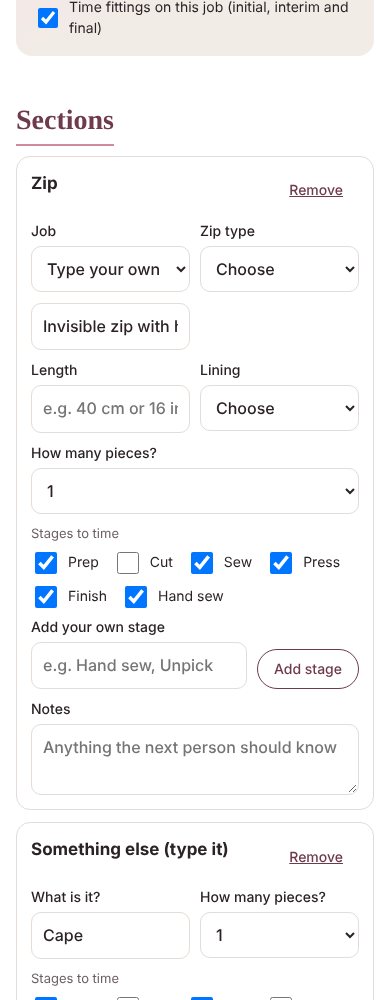
- Time your own jobs. Our free bridal sewing stopwatch records each job by stage, so after a month you'll have real averages.
- Start from a benchmark. The Bridal Alterations Time Guide gives a usual time and a realistic range for over 40 bridal jobs at each level of complexity, with notes on what pushes each one up. Use it until your own data takes over.
Putting it all together
Once you have your rate and your times, building a full price list is just multiplication, but it's a lot of multiplication. The Price Sheet Builder does it for you: enter one hourly rate and it fills in a full bridal price list by complexity, with small parts per unit and materials on their own line. Change your rate next year and every price updates.
Want brides to see a guide before they enquire? The Website Price List Maker builds a paste-in price guide for your own website from your hourly rate and times, with ranges for sheath, A-line and ballgown dresses.
Still working out the rate itself? The free Pricing Calculator is a good place to start. If you're new to bridal work, how to start an alterations business covers the setup side, and our sample wedding gown alterations price list shows what a finished list looks like.
Tools built for seamstresses, not brides
Most alterations websites are written for brides. The Bridal Sewing Room is different. Every product we make is for seamstresses, to help you build a bridal business that pays you properly, and each one is built and used inside a working bridal studio.
More are on the way, including contract wording for your bridal clients. Follow The Bridal Sewing Room on Gumroad and you'll hear when each new one comes out.
Further reading: - How to start a tailoring business (Lawpath)
Price your work properly
Tools made inside a working bridal studio, from a free hourly rate calculator to a ready-made price sheet.
Browse the shop